
Mortgage education
Closing Costs in Bexar County, Line by Line
Most of a closing bill is not set by the lender. Knowing which lines are, and which are fixed by the state or the county, tells you where there is anything to discuss.
The short answer
Three kinds of line, only one of them yours to shop.
A Bexar County closing bill splits three ways: what the lender charges to make the loan, what outside companies charge to close it, and what you pay in advance for taxes, insurance, and interest. Texas fixes the title premium by rule. The county fixes the recording fee. The rest is where the differences live.
A calculator gives you a number. The Closing Disclosure gives you a number and the sections that produced it, and the sections are the part worth learning. They separate the charges a lender sets from the ones that are identical at every title company in the state, and both of those from the money that is simply yours arriving early.
What follows is a reading guide for your own paperwork. There are no sample totals here, because a total assembled from someone else’s assumptions is not evidence about your file. The rules, the promulgated rates, and the county’s published fees are the same for everyone, so those are what this covers.
One page, two tables
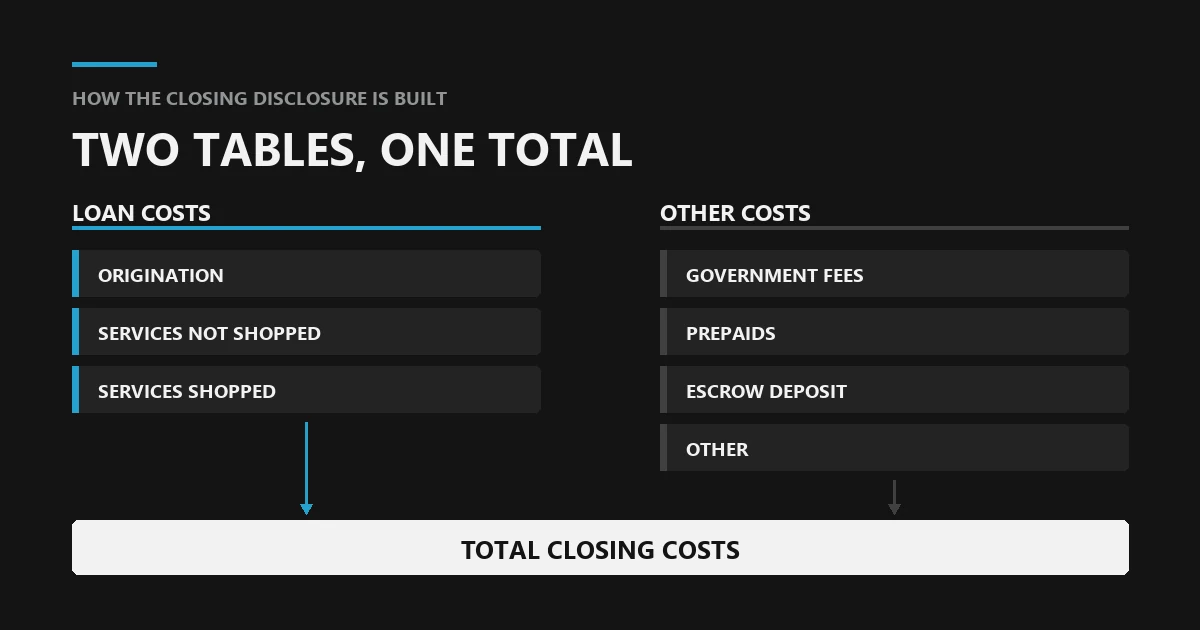
Page two of the Closing Disclosure looks like a long list and is not one. It is two tables stacked together, and the seam between them is the most useful line on the form.
The first table is headed “Loan Costs.” 12 CFR 1026.38(f) builds it from three lettered groups: “Origination Charges,” “Services Borrower Did Not Shop For,” and “Services Borrower Did Shop For,” followed by a “Total Loan Costs (Borrower-Paid)” line.
The second table is headed “Other Costs.” Under 1026.38(g) it runs “Taxes and Other Government Fees,” “Prepaids,” “Initial escrow payment at closing,” and “Other.” The two tables then meet at “Total Closing Costs (Borrower-Paid).”
That division is not cosmetic. The first table is the cost of borrowing. The second is mostly the cost of owning, and it would exist in some form even if you paid cash. Reading a single blended total hides that, which is why two files with the same bottom line can be priced very differently.
The lender’s side of the page
Three groups sit under Loan Costs, and the difference between the second and the third is the one that matters to you.
- Origination Charges
- What the lender charges to make the loan, itemized, plus any compensation the creditor pays a third-party loan originator, named. Points belong here. This group is the lender’s own pricing.
- Services Borrower Did Not Shop For
- Services the creditor required, provided by someone other than the creditor or broker, where you did not shop. The regulation requires the name of the person ultimately receiving each payment. An appraisal usually lands here.
- Services Borrower Did Shop For
- The same kind of third-party service, for items where you did shop. If the lender gave you a written list of providers and you picked one from it, the charge is disclosed in the group above instead.
The reason to care is that the group a charge sits in decides how much it is allowed to change later. That is the subject of a section further down, and it is the single most practical thing on the form.
Before any of this, a lender has to give you a written list of the services you are permitted to shop for. That list, and what to do with it, is worth reading alongside your estimate.
Everything else
The second table is where most Bexar County buyers find the numbers they did not expect, and almost none of them are lender charges.
- Taxes and other government fees. Recording fees come first. The regulation requires the form to show the total for recording deeds and, separately, the total for recording security instruments, then the combined amount. Texas does not impose a real estate transfer tax, and it cannot start one: Article VIII, Section 29 of the Texas Constitution, added in 2015, provides that “After January 1, 2016, no law may be enacted that imposes a transfer tax on a transaction that conveys fee simple title to real property.” The transfer tax lines that fill this section of the form in other states are normally blank here.
- Prepaids. Charges paid ahead for a period rather than for a service: interest from closing to the end of the month, the first year of homeowner’s insurance, property taxes. These are not fees. They are your own obligations, front-loaded.
- Initial escrow payment at closing. The cushion the servicer collects so the escrow account can pay taxes and insurance when they come due. The form also shows an aggregate adjustment line, which is a reconciliation, not a charge.
- Other. Costs in the transaction beyond the groups above, including an owner’s title policy where the buyer pays it.
Bexar County property taxes deserve their own attention, because the prepaid and escrow lines follow from them and they are the reason two identical loan amounts can produce different monthly numbers. The property tax and escrow guide covers that separately.
Texas fixes the title premium, and that changes how you shop
This is where advice written for a national audience stops being useful in San Antonio.
Title insurance rates in Texas are regulated. The Texas Department of Insurance states plainly that “All title companies will charge the same premium for a policy,” that “The premium rate is set by the Texas Department of Insurance,” and that a discount is not available. The premium also buys more here than the word “insurance” suggests: it “includes charges for additional services such as the title search, the title examination, and closing the transaction.”
So comparing title companies on premium is not a thing you can do. The premium is arithmetic. Under the rate schedule effective March 1, 2026, a policy of exactly $100,000 carries a basic premium of $780, and above that the schedule sets out four steps: find the range containing the policy’s face value, subtract the figure in the second column, multiply by the figure in the third, round to the nearest dollar, and add the figure in the fourth. For face amounts from $100,001 to $1,000,000 those figures are $100,000, 0.00494, and $780.
Run it on a $300,000 policy and you get $200,000 × 0.00494 = $988, plus $780, for a basic premium of $1,768. The department publishes its own worked example at $268,500, which comes to $1,612 by the same steps. Your own number is the one produced by your policy amount, and it will be the same wherever you close.
Two consequences follow, and the second one surprises people.
First, if you want to shop, shop the escrow fee and the add-ons. The department points at exactly that: “You can shop around for cheaper escrow fees, or closing costs. These differ between agents.” It also confirms you are free to make that choice at all, since “You may choose any title company you want; you don’t have to use a company selected by a real estate agent, builder, or lender.”
Second, the loan policy your lender requires is cheap only because the owner’s policy is being bought with it. The department’s answer is direct: “When an owner’s policy and a loan policy are purchased at the same time, the loan policy is issued at a discounted price of $100. If you decide not to purchase an owner’s policy, you will pay full price for the loan policy.” Declining the owner’s coverage to save money does not remove the premium from the closing. It moves the full premium onto the policy that protects the lender instead of you.
Who pays the owner’s premium is a separate question from what it costs. The department notes the buyer and seller may negotiate it, and in a Texas purchase that allocation is written into the contract rather than decided at the closing table.
What Bexar County actually charges to record
Recording is a county function, and Bexar County publishes its schedule. Effective January 1, 2024, the county clerk lists $25.00 for the first page and $4.00 for each additional page, per document. The county also itemizes what makes up that first-page fee: a $5.00 recording fee, a $10.00 records management fee, and a $10.00 records archive fee.
The arithmetic is $25, plus $4 for every page after the first. What trips people up is the words per document. A purchase records more than one instrument, and each is priced on its own page count, so a single blended guess will be wrong in one direction or the other.
Count the pages of each recorded instrument and price them separately. A three-page document costs $25 + (2 × $4) = $33. An eighteen-page document costs $25 + (17 × $4) = $93. Those two together come to $126, and that is a calculation about page counts, not a claim about your file. Your closer can tell you what is being recorded before you sign.
This also explains why recording is the one government line the regulation treats loosely, which the next section covers.
Which numbers are allowed to move, and by how much
An estimate is a promise of a particular strength, and Regulation Z sets three different strengths. Most articles present this as a list of “zero tolerance items.” The regulation is built the other way around, and the difference matters.
12 CFR 1026.19(e)(3)(i) starts with the strict rule and applies it to everything: an estimated closing cost “is in good faith if the charge paid by or imposed on the consumer does not exceed the amount originally disclosed.” Zero increase is the default. Everything else is a carve-out.
The first carve-out is a group, not a line. Under (e)(3)(ii), an estimate for a third-party service or a recording fee is in good faith if the aggregate of those charges “does not exceed the aggregate amount of such charges disclosed … by more than 10 percent,” provided the charge is not paid to the creditor or an affiliate and the creditor “permits the consumer to shop for the third-party service.” Because it is measured in aggregate, one line can rise well past 10 percent while the group still complies.
The second carve-out drops the ceiling entirely. Under (e)(3)(iii), certain charges are in good faith if the estimate “is consistent with the best information reasonably available to the creditor at the time it is disclosed,” whatever the final figure. The regulation lists prepaid interest, property insurance premiums, “Amounts placed into an escrow, impound, reserve, or similar account,” charges to providers you selected off the lender’s written list, and property taxes and other charges for services the creditor did not require.
Read those two lists next to the tables above and the form starts to make sense. The costs with no ceiling are almost exactly the second table: prepaids and escrow. That is not a loophole. Nobody can know your exact per-diem interest before the closing date is set, or your escrow deposit before the tax bill is certified.
Increases outside those allowances need a reason the regulation recognizes. Paragraph (e)(3)(iv) permits a revised estimate for a changed circumstance, defined to include “An extraordinary event beyond the control of any interested party or other unexpected event specific to the consumer or transaction,” information relied on that turned out to be inaccurate or changed, or new information the creditor did not rely on originally. A revision requested by you counts as well. “The price went up” on its own does not appear on that list.
Timing is fixed too, in two separate places. Under 1026.19(f)(1)(ii)(A) the creditor must ensure you receive the Closing Disclosure “no later than three business days before consummation.” Under 1026.19(f)(1)(iii), headed “Receipt of disclosures,” anything not handed to you in person counts as received “three business days after they are delivered or placed in the mail.” A mailed disclosure therefore has to leave earlier than people assume. Those days exist so you can do the comparison in this article before signing, not after.
VA files follow an extra rulebook
A large share of purchases around Joint Base San Antonio run on VA financing, and VA limits what a lender may charge in a way conventional rules do not.
The baseline is a prohibition. 38 CFR 36.4313(b) states that “no brokerage or service charge or their equivalent may be charged against the debtor or the proceeds of the loan.” From there the regulation grants back a specific list. Paragraph (d)(1) provides that “The veteran may pay reasonable and customary amounts” for enumerated items, including “Recording fees and recording taxes or other charges incident to recordation,” “Title examination and title insurance, if any,” the credit report, the appraisal, hazard insurance, survey where required, flood zone determination, and the tax and insurance deposit.
Then comes the ceiling on origination. Paragraph (d)(2) allows a lender to charge “a flat charge not exceeding 1 percent of the amount of the loan, provided that such flat charge shall be in lieu of all other charges relating to costs of origination not expressly specified and allowed in this schedule.” The phrase to hold onto is in lieu of. A lender that takes the flat charge cannot also itemize origination costs that the schedule does not separately name.
That gives a VA borrower a concrete review to run on the Origination Charges group: identify whether the lender took the flat charge or itemized, and confirm each itemized origination line appears on the allowed schedule. It is a narrow check, and it applies to origination costs, not to the third-party and prepaid lines in the second table.
The VA funding fee is a separate matter with its own schedule, which varies by down payment and by whether it is a first or subsequent use, and which is waived for some borrowers. Because that schedule changes, it is worth reading from VA’s own funding fee page rather than any summary of it, including this one. The VA cost page here covers the structure, and the broader VA home loan section covers eligibility and entitlement.
Credits, and what they actually do to cash to close
Two different things reduce what you bring, and they behave differently on the form.
A lender credit appears in the closing cost totals “as a negative number, labeled ‘Lender Credits.’” There is a detail in that same paragraph worth knowing: if the credit is there because a charge exceeded the tolerance limits, the form must state that the amount includes a credit for an amount exceeding the limits on increases in closing costs. A lender credit that appears late, without explanation, may be a cure rather than a concession. The form is required to tell you which.
A seller credit is negotiated in the contract and is capped by the loan program, not by Regulation Z. On conventional financing the limits run through interested party contribution rules, which set what a seller, agent, or lender may contribute based on occupancy and down payment. Those limits have their own article, because they are the constraint people most often discover too late.
VA counts concessions differently, and narrowly. VA’s guidance describes a 4 percent seller concession consisting only of specified items, including payment of the buyer’s funding fee, payment of prepaid taxes and hazard insurance, points beyond what is appropriate to the market, payment of points for a temporary buydown, gifts, and paying off credit balances or judgments on the veteran’s behalf. The 4 percent “is based on the established reasonable value of the property.” Ordinary closing costs sit outside that cap: VA states that title insurance, title exam, the appraisal, the origination fee, and normal discount points “can be paid by the seller and they don’t count toward the concession.”
That asymmetry is easy to get backwards. On a VA file, a seller paying your title and origination costs is generally not spending the 4 percent allowance at all.
Reading your own estimate
Put your Loan Estimate next to your Closing Disclosure and work through it in this order. Every step here is a comparison you can make yourself.
- Total the first table and the second table separately on both documents. A rise concentrated in the second table has a different explanation than a rise in the first.
- In Origination Charges, check whether anything appeared that was not on the estimate. This group carries the strict rule.
- Compare the third-party services and recording fees as a group, not line by line. The 10 percent allowance is measured across the group.
- Recalculate the title premium from your policy amount using the four steps and the current rate schedule. It should match, because it is fixed.
- Confirm the loan policy is priced at the simultaneous-issue amount, and that an owner’s policy is in fact being issued.
- Count the pages of each instrument being recorded and price them at $25 plus $4 per additional page.
- On prepaids and escrow, check the assumptions rather than the totals: the closing date behind the per-diem interest, and the tax figure behind the escrow deposit.
- If a lender credit appeared or grew, read whether the form describes it as covering an amount exceeding the limits on increases.
- On a VA file, confirm the origination treatment is either the flat charge or itemized allowable fees, not both.
Where a number moved, the question to ask is not whether it is high. It is which of the three strengths applied to that line, and what changed. Sequencing questions like these across the transaction is covered in who does what from preapproval to closing, and the documents to gather first are in the first conversation checklist. For the category map behind all of this, see the Texas closing costs guide.
Educational scope: This page explains federal regulation, Texas promulgated rates, and published county fees. It is not a commitment to lend, does not predict approval, does not quote a rate, payment, or loan term, and does not estimate the closing costs of any particular transaction. Promulgated rates and county fee schedules change; read the current schedule for your closing date.
Official sources
Source review completed September 4, 2026. Every figure above is quoted from the publisher named beside it.
- Consumer Financial Protection Bureau, eCFR, 12 CFR 1026.19 — Certain mortgage and variable-rate transactions. Text as in force September 1, 2026. Accessed September 4, 2026.
- Consumer Financial Protection Bureau, eCFR, 12 CFR 1026.38 — Content of disclosures for certain mortgage transactions (Closing Disclosure). Text as in force September 1, 2026. Accessed September 4, 2026.
- Texas Department of Insurance, Texas Title Insurance Basic Premium Rates. Rates effective March 1, 2026. Accessed September 4, 2026.
- Texas Department of Insurance, Title insurance FAQ. Accessed September 4, 2026. Qualitative statements only; premium figures in this article are taken from the rate schedule above, which supersedes the illustrative examples on the FAQ page.
- Bexar County Clerk, Real Property Recording Fees. Effective January 1, 2024. Accessed September 4, 2026.
- Texas Constitution, Article VIII, Section 29 (transfer tax on conveyance of fee simple title prohibited). Added November 3, 2015. Accessed September 4, 2026.
- U.S. Department of Veterans Affairs, eCFR, 38 CFR 36.4313 — Charges and fees. Text as in force September 1, 2026. Accessed September 4, 2026.
- U.S. Department of Veterans Affairs, VA funding fee and closing costs. Accessed September 4, 2026.
- U.S. Department of Veterans Affairs, VA Credit Standards course, seller concessions. Accessed September 4, 2026. VA Pamphlet 26-7 is the controlling lender policy.
- Consumer Financial Protection Bureau, Closing Disclosure explainer. Accessed September 4, 2026.
- Texas Department of Savings and Mortgage Lending, Mortgage Origination Laws and Regulations. Current rule index. Accessed September 4, 2026.