
Mortgage education
Borrower-Requested PMI Cancellation and Automatic Termination
The dates are set at closing and measured against original value. Knowing which date is yours is most of the work.
The short answer
Two exits, plus a backstop.
Federal law gives a conventional borrower two separate paths off private mortgage insurance. You can request cancellation at 80 percent of the home’s original value, and the servicer must terminate automatically at 78 percent. Both figures use original value, not today’s market value. FHA and VA loans follow different rules entirely.
Almost every argument about PMI comes down to one question: which value is being measured. The Homeowners Protection Act answers that question once, at the beginning of the loan, and then never changes its mind. Understanding that single choice explains most of what follows.
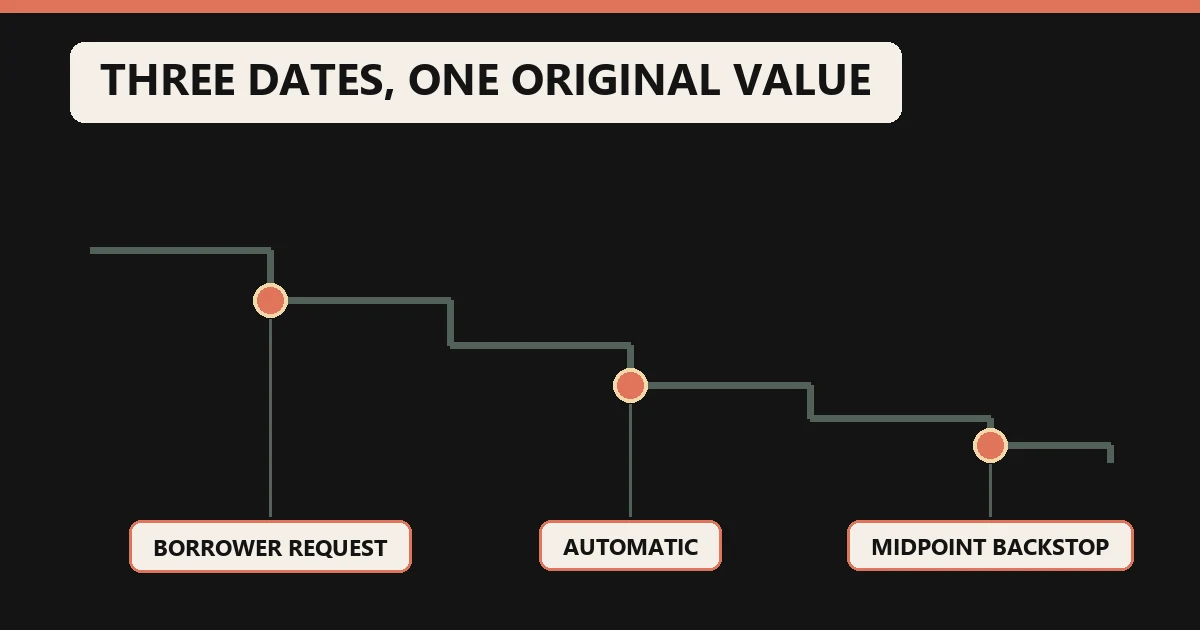
The statute builds three dates, not one
12 U.S.C. §4902 creates three separate ways a private mortgage insurance requirement ends. They are not alternatives you choose between. They stack, and the earliest one that applies is the one that takes effect.
- The cancellation date
- The borrower asks. Under §4901(2), this is the date the principal balance is first scheduled to reach 80 percent of original value, or the date it reaches 80 percent based on actual payments, at the borrower’s option.
- The termination date
- The servicer acts without being asked. Under §4901(18), this is the date the balance is first scheduled to reach 78 percent of original value, based solely on the amortization schedule and “irrespective of the outstanding balance for that mortgage on that date.”
- Final termination
- The backstop. Under §4902(c), the requirement cannot be imposed beyond the first day of the month after the midpoint of the loan’s amortization period, if the borrower is current. On a 30-year loan that midpoint arrives after 15 years, whatever the balance happens to be.
The difference between the first two matters in practice. The 80 percent path requires you to do something. The 78 percent path requires the servicer to do something. A borrower who waits for the automatic date gives up the earlier one.
“Original value” is the phrase that decides everything
This is where most confusion starts. The statute does not measure against what the home is worth now. §4901(12) defines original value as “the lesser of the sales price of the property securing the mortgage, as reflected in the contract, or the appraised value at the time at which the subject residential mortgage transaction was consummated.” For a refinance of a principal residence, it means “only the appraised value relied upon by the mortgagee to approve the refinance transaction.”
So a purchase where the contract price came in under the appraisal uses the contract price. A market that has since risen does not move the statutory date, because the statutory date was fixed at closing.
That is the federal floor, not the ceiling. A servicer, investor, or mortgage insurer may run its own program that considers a current appraisal or broker price opinion. Those programs exist and are worth asking about, but they are contractual rather than statutory. If a servicer declines a current-value request, it has not necessarily violated the Homeowners Protection Act. Ask which of the two you are being told about.
The Consumer Financial Protection Bureau states the same rule in plain language: “original value” generally means either the contract sales price or the appraised value at the time of purchase, whichever is lower, and the appraised value at the time of the refinance for a refinanced loan.
What a borrower request actually has to satisfy
§4902(a) lists four conditions. All of them have to be met before a cancellation takes effect, and a request that skips one is not a denial of your rights, it is an incomplete request.
- A written request. The statute says the mortgagor “submits a request in writing to the servicer that cancellation be initiated.” A phone call does not start the clock.
- A good payment history. §4901(4) defines this precisely: no payment 60 days or more past due in the 12-month period beginning 24 months before the relevant date, and no payment 30 days or more past due in the 12 months preceding it.
- Current on payments. Separate from payment history, and measured at the time of the request.
- Whatever the holder requires on value and liens. The holder may require evidence that the property has not declined below original value, and certification that your equity is unencumbered by a subordinate lien. A home equity line taken out after closing can sit in the way of an otherwise clean request.
On the evidence requirement, the statute expects the servicer to tell you the rules rather than invent them afterward. The evidence must be “of a type established in advance and made known to the mortgagor by the servicer promptly upon receipt” of the request. It is reasonable to ask, in writing, what form of evidence the holder accepts before you pay for anything.
Automatic termination asks nothing of you except being current
§4902(b) puts the work on the servicer. On the termination date, the requirement ends if the borrower is current. If the borrower is not current on that date, it ends on the first day of the first month after the account is brought current. No request, no appraisal, and no certification.
The wording is worth reading twice: the 78 percent date is measured “based solely on the initial amortization schedule” and “irrespective of the outstanding balance.” Extra principal payments can move the 80 percent cancellation date forward, because §4901(2) offers an actual-payments option. They do not move the 78 percent automatic date, which stays on the original schedule.
After either event, §4902(e) bars further premiums more than 30 days out, and §4902(f) requires all unearned premiums to be returned to the borrower within 45 days.
This chapter does not cover FHA, VA, or USDA charges
The exclusion is written into the definition. §4901(13) defines private mortgage insurance as “mortgage insurance other than mortgage insurance made available under the National Housing Act, title 38, or title V of the Housing Act of 1949.” Those three citations are FHA, VA, and USDA.
The practical consequence is that none of the dates above govern an FHA annual mortgage insurance premium. FHA sets its own rules for how long that premium stays on a loan, and the answer depends on the case. VA-backed loans do not carry a monthly mortgage insurance premium at all; their cost structure is different, and the VA cost page covers it separately.
If someone tells you your FHA loan will “drop the PMI at 78 percent,” they are applying a conventional rule to a government program. Confirm which program the loan is actually under before planning around a date.
What has to arrive in writing
12 U.S.C. §4904 is the section most borrowers never hear about, and it is the most useful one to know. Within 30 days of a cancellation or termination, the servicer must notify you in writing that the insurance has ended and that no further premiums, payments, or other fees are due.
The denial side is stronger. If the servicer determines that the loan did not meet the requirements, §4904(b) requires written notice of “the grounds relied on to make the determination (including the results of any appraisal used to make the determination).” A verbal no is not the notice the statute contemplates. If you get one, ask for the written grounds and the appraisal result.
The Bureau has supervised this area directly. Its 2015 compliance bulletin was issued to help servicers comply with the cancellation and termination provisions and “describes examples from CFPB’s supervisory experience of PMI cancellation and termination procedures that violate the HPA or create a substantial risk of noncompliance.” The existence of that bulletin is a reasonable reason to put a request in writing and keep a copy.
Three qualifications that change the math
Loans consummated before July 29, 1999
§4901(15) defines a residential mortgage transaction as one consummated on or after the date one year after July 29, 1998. An older loan sits outside the chapter, and any cancellation depends on the note, the servicer, and investor policy.
High-risk loans
§4902(g) removes the borrower-request and automatic-termination provisions for a transaction that had high risks associated with the extension of the loan at consummation. For a loan above the applicable conforming limit, where the mortgagee makes that determination, termination instead occurs when the scheduled balance first reaches 77 percent of original value. The midpoint backstop in §4902(c) still applies either way.
Loan modifications
§4902(d) says that if the parties agree to modify the terms or conditions of the loan, the cancellation date, termination date, and final termination are recalculated to reflect the modified terms. A modification resets the schedule the dates were drawn from.
Questions worth asking, and who to ask
One structural point first: the servicer handles cancellation, not the loan officer who originated the file. If your loan was sold or transferred, the request goes to whoever collects the payment today. A loan officer can explain how the dates were set and read the disclosure with you. They cannot cancel insurance on a loan they do not service.
- What is the original value on this loan, and which figure produced it?
- What are the scheduled 80 percent and 78 percent dates on my amortization schedule?
- What evidence of current value does the holder require, and in what form?
- Is there a subordinate lien recorded against the property?
- Is this loan conventional, FHA, VA, or USDA?
- If a request is declined, may I have the written grounds and any appraisal result?
For related sequencing, see what a lender reviews for affordability and the down payment and cash-to-close guide.
Educational scope: This page explains federal statutory rights and public agency guidance. It is not a commitment to lend, does not predict approval, does not quote a rate, payment, or premium, and does not evaluate any particular loan.
Official sources
Source review completed September 2, 2026.
- Office of the Law Revision Counsel, 12 U.S.C. §4901 — Definitions. Text in effect on September 1, 2026. Accessed September 2, 2026.
- Office of the Law Revision Counsel, 12 U.S.C. §4902 — Termination of private mortgage insurance. Text in effect on September 1, 2026. Accessed September 2, 2026.
- Office of the Law Revision Counsel, 12 U.S.C. §4903 — Disclosure requirements. Text in effect on September 1, 2026. Accessed September 2, 2026.
- Office of the Law Revision Counsel, 12 U.S.C. §4904 — Notification upon cancellation or termination. Text in effect on September 1, 2026. Accessed September 2, 2026.
- Consumer Financial Protection Bureau, When can I remove private mortgage insurance (PMI) from my loan?. Accessed September 2, 2026.
- Consumer Financial Protection Bureau, Bulletin 2015-03: private mortgage insurance cancellation and termination. Published August 4, 2015; page last modified August 11, 2023. Accessed September 2, 2026.
- Consumer Financial Protection Bureau, eCFR, 12 CFR 1026.24 — Advertising. Accessed September 2, 2026.
- Consumer Financial Protection Bureau, eCFR, 12 CFR 1014.3 — Prohibited representations. Accessed September 2, 2026.
- Texas Department of Savings and Mortgage Lending, Mortgage Origination Laws and Regulations. Current rule index. Accessed September 2, 2026.
- Texas Department of Savings and Mortgage Lending, Mortgage Origination FAQs. Current FAQ. Accessed September 2, 2026.