
Mortgage education
How Condominium Project Review Affects a Mortgage File
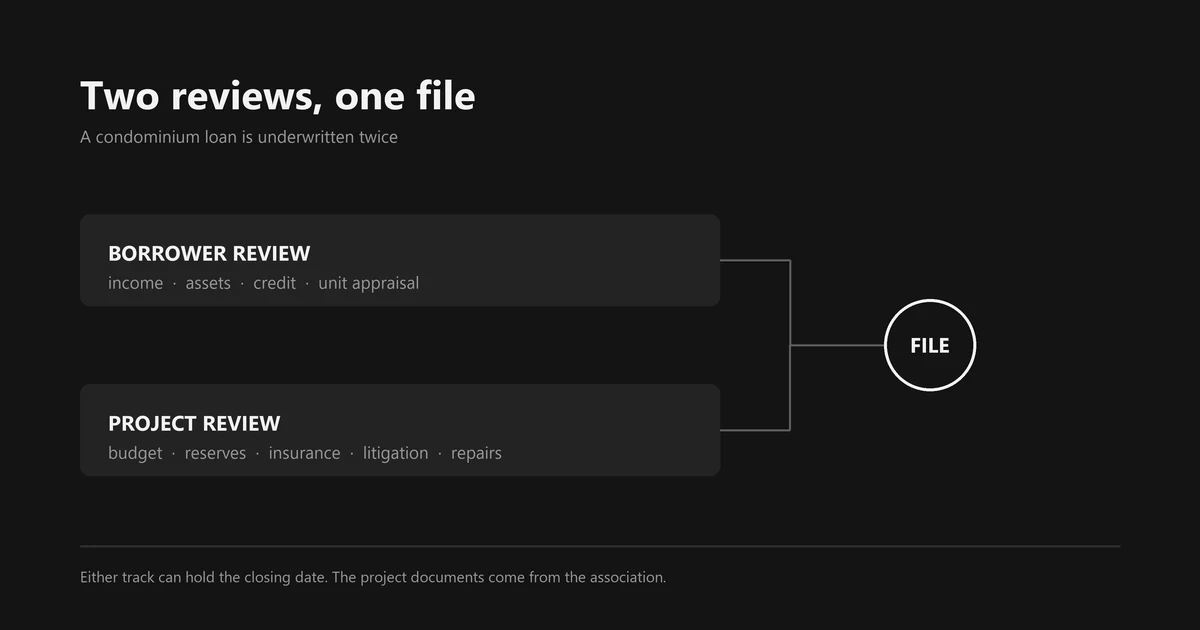
Your income, credit, and appraisal are one review. The association budget, reserves, insurance, litigation, and repair history are a second one, running beside it.
The short answer
Your file has a second borrower, and it is the building.
A condominium loan underwrites two things: you and the project around you. Alongside your income, credit, and appraisal, the lender reviews the association’s budget, reserves, insurance, litigation, and repair history. A project that fails those tests can stop a file that is otherwise finished, and almost none of that paperwork is yours to produce.
Most of what a borrower does during a mortgage is about the borrower. You gather pay stubs, you explain a deposit, you sign what arrives. On a condominium, a second review runs beside that one, and it is about the association. Fannie Mae puts the distinction plainly: “Project eligibility risk is a risk that is distinct from the credit risk presented by individual borrowers.”
The practical consequence is that a condo file has a failure mode a house does not. You can be approved and the loan can still be ineligible, because the problem is thirty units away in a reserve account you have never seen.
Two reviews, one closing date
The project review is not a subset of your underwriting. It is a parallel track. Fannie Mae’s guide describes it as work done “in addition to the review the lender completes for underwriting the borrower, the transaction terms, and the individual unit appraisal.”
That matters for scheduling more than for anything else. Your side of the file has a rhythm you can influence: send the document, answer the question, wait a day. The project side depends on a management company that has no contractual relationship with you, no stake in your closing date, and often a published turnaround of a week or two for a questionnaire. When people say a condo closing “took longer,” this is usually where the time went.
It also means the two tracks can finish out of order. A file can sit fully approved on the borrower side for a week while the association’s budget is still being read.
Not every condo gets the same review
Before anything else happens, the lender decides which review method applies, and the answer depends on the building rather than on you. Fannie Mae keys it to the number of units, whether the unit is attached or detached, whether the project is new or established, and the transaction itself.
Some units skip the deep review entirely. Fannie Mae “does not require a thorough project review for several types of projects or loan transactions,” and the list includes detached condo units, units in a two- to ten-unit condo project, and attached units in a five- to ten-unit condo project that is not part of a larger development or master association. If you are buying a detached unit in a small project, the paragraphs below may never come up.
An attached unit in a larger project is the common case, and it draws a Full Review. The lender runs that through Condo Project Manager, Fannie Mae’s web tool, and must “document the loan file with the CPM decision by including the unexpired CPM Certification in the file.” A separate path exists for established projects already approved by FHA.
Ask which of these applies early. It is the single question that predicts how much association paperwork your closing will need.
What the association has to produce
The document list is not fixed. Lenders decide what they need to prove the project qualifies, and Fannie Mae’s illustrative list runs to legal and recorded documents, “project budgets, financial statements, and reserve studies,” architects’ or engineers’ reports, evidence of insurance, and condominium project questionnaires.
That questionnaire is the piece buyers hear about. Fannie Mae publishes it as Form 1076, and its status surprises people: “This form is optional; however, lenders are encouraged to use and retain the form in the loan file. A substantially similar form may also be used in its place.” Optional to Fannie Mae is not optional to your lender, who still has to answer every question on it from somewhere.
None of this is in your closet. The budget, the reserve study, the insurance certificate, the minutes, and the delinquency figures all live with the HOA or its management company, and many management companies charge a fee and take their own time to assemble them. Getting that request submitted in the first days after the contract is signed is worth more than any document you can personally send faster. The same principle applies to the rest of the file, which is why the first conversation with a lender is largely a list of questions.
The thresholds a project has to clear
Under a Full Review, several of the tests are arithmetic on the association’s own numbers. These are the ones worth knowing, because a buyer can sometimes learn the answers before writing an offer.
- Delinquent assessments
- “No more than 15% of the total units in a project are 60 days or more past due on common expense assessments (also known as HOA fees).” The guide works the example: a 100-unit project may not have more than 15 units that far behind. A separate 15% test applies to each special assessment.
- Replacement reserves
- The lender must find that the budget “provides for the funding of replacement reserves for capital expenditures and deferred maintenance that is at least 10% of the budget.” A qualifying reserve study can be used instead of that calculation, but a study cannot be used to waive the 10% floor by projecting a balance that merely never reaches zero.
- Single-entity ownership
- One owner holding too much of a project makes it ineligible. The limits are two units in projects of 11 to 20 units, two units in projects of 5 to 10 units that are part of a master association, and 20% in projects of 21 or more units.
- Commercial space
- “The total space that is used for nonresidential or commercial purposes may not exceed 35%.” This is what catches some conversions with ground-floor retail.
Read the last one alongside the hotel rules. A project managed like a hotel is ineligible regardless of its finances, and the guide treats short-term rental machinery as the tell: rental pooling requirements, daily cleaning, central key systems, or a name containing “hotel” or “resort” that is not purely historical.
Critical repairs are the newest reason a file stalls
Projects “in need of critical repairs” are ineligible, and the definition is broader than the phrase sounds. It covers repairs or replacements that significantly affect “the safety, soundness, structural integrity or habitability of the project’s building(s), or the financial viability or marketability of the project,” including mold, water intrusion, advanced physical deterioration, and a failure to pass a jurisdiction’s mandatory structural safety inspection.
One line in that definition is a number, and it is the one to remember: “any unfunded repairs costing more than $10,000 per unit that should be undertaken within the next 12 months.” Repairs already funded through a special assessment within guidelines are excluded, as are repairs a unit owner makes.
Special assessments therefore get read rather than counted. The lender has to establish what the assessment is for, when it was approved, whether it is planned or already being collected, the original and remaining amounts, and when it will be paid in full. If the assessment is tied to a critical repair that has not been fixed, the project is ineligible.
Two further rules catch buildings that have already been examined. A structural or mechanical inspection completed within three years of the review must be obtained and read, and it cannot show unaddressed critical repairs. A project under an evacuation order, partial or total, is ineligible until the condition is remediated and the building is deemed safe for occupancy.
This is the cluster that changed most after the 2021 Surfside collapse, and it is why board meeting minutes now matter to your loan. A discussion of a balcony repair, recorded in minutes, is evidence the lender is obliged to follow up on.
Litigation, and what counts as minor
Pending litigation naming the HOA does not automatically end a file, but the test is specific. A project is ineligible when the association is a party to litigation, or the sponsor or developer is a party to litigation, “that relates to the safety, structural soundness, habitability, or functional use of the project.”
Matters outside that description can still qualify as minor. The guide lists non-monetary disputes such as neighbor disagreements and rights of quiet enjoyment, litigation the insurance carrier has agreed to defend and that the association’s insurance covers, an association suing to collect past-due assessments or to foreclose, and matters where “the reasonably anticipated or known damages and legal expenses are not expected to exceed 10% of the project’s funded reserves.”
Construction defect suits are treated harder. When the association is the plaintiff, the matter is not minor unless it is seeking recovery for problems already repaired and losing the case would not materially hurt the association. Arbitration and mediation are handled as litigation once they are reasonably expected to proceed.
FHA and VA keep their own lists
Conventional review is not the only rulebook, and a project can sit differently on each list. For FHA, the requirement is approval as such: a unit must be “located in a Condominium Project approved by HUD or a DELRAP mortgagee approved under § 203.8, or meet the additional requirements for approval as a Site Condominium or Single-Unit Approval,” under 24 CFR 203.43b.
The regulation sets ranges and leaves the exact figure to HUD notice, which is why quoting a single percentage from memory is unreliable. Owner occupancy must fall “within a range between 30 and 75 percent” of units. Commercial and non-residential space sits in a range between 25 and 55 percent of total floor area. The share of units carrying FHA-insured mortgages runs in a range between 25 and 75 percent, and HUD may suspend new case numbers in a project that exceeds the concentration it has set.
Single-Unit Approval is the route for a unit in a project that is not on the approved list. Among other conditions, the project must be complete, must not be under an adverse determination, and must have at least five dwelling units, and the unit cannot be a manufactured home.
VA governs condominium loans through 38 CFR 36.4360, which makes a loan on a unit in a condominium development “eligible for guaranty or insurance to the same extent and on the same terms as other loans under 38 U.S.C. 3710,” subject to the condominium provisions that follow. If you are buying near a JBSA report date, confirming the project’s standing on the VA side belongs in the first week, not the third.
Approval is a snapshot, not a guarantee
A project’s status can move while your file is open. If a lender learns of something that could affect eligibility, such as significant deferred maintenance or major litigation, it has to notify Fannie Mae’s project team, and “notification must occur as soon as practicable but no later than five business days after becoming aware of such information.” Fannie Mae in turn “reserves the right to change a project eligibility status designation if information acquired after approval or certification has an impact on a previously issued eligibility determination.”
Certifications and approvals also expire, and eligibility is measured as of the note date rather than the day the questionnaire came back. A long contract, a construction delay, or a rate lock extension can outlive the paperwork that supported the review, which is one more reason condo files get re-checked close to closing.
What to ask before you write the offer
Nothing here is secret. Most of it is knowable in the days before an offer, and knowing it changes which unit you chase.
- Is the unit attached or detached, and how many units are in the project? That answer alone often decides whether a full project review happens.
- Is there a special assessment now, planned, or recently discussed? Ask what it is for, not just how much.
- Has the project had a structural or mechanical inspection in the last three years, and what did it say?
- What share of units is behind on dues by sixty days or more?
- Does the budget fund reserves, and is there a reserve study?
- Is the association involved in any litigation, and does it touch the building itself?
- Does one owner hold a large block of units?
- If you are using FHA or VA financing, is the project on that agency’s approved list today?
A seller’s agent can usually get most of this from the association faster than a lender can, and asking before the contract is signed costs nothing. It is the same instinct that makes an early lender conversation useful: the expensive surprises are the ones that arrive after you are committed.
If a project turns out to be ineligible for one program, that is not always the end of the purchase. Conventional, FHA, and VA apply different tests, and a unit that fails one list can sometimes clear another. That comparison is a conversation to have with the specific project in front of you, and it belongs early in the sequence, while there is still time to act on the answer.
Educational scope: This page explains project eligibility requirements published by Fannie Mae, HUD, and VA. Every threshold quoted belongs to one of those agencies rather than to this lender, and a given project is measured against the rules in force on its own note date. It is not a commitment to lend, does not predict approval, and does not quote a rate, payment, or loan term. Agency guides are revised; read the current one for your closing date.
Official sources
Every rule and quoted phrase above comes from one of these. Each was retrieved and read on September 7, 2026.
- Fannie Mae Selling Guide, B4-2.1-01, General Information on Project Standards, topic dated August 5, 2026. Project risk, documentation, Form 1076, project types, review methods, and waiver of project review.
- Fannie Mae Selling Guide, B4-2.2-01, Full Review Process, topic dated August 5, 2026. Condo Project Manager, certification, delinquency and reserve requirements, and the five-business-day notification duty.
- Fannie Mae Selling Guide, B4-2.1-03, Ineligible Projects, topic dated August 5, 2026. Hotel operations, commercial space, litigation, single-entity ownership, critical repairs, and special assessments.
- 24 CFR 203.43b, Eligibility of mortgages on single-family condominium units, Electronic Code of Federal Regulations, title 24 current as of September 3, 2026. FHA project approval, the statutory ranges, and Single-Unit Approval.
- 38 CFR 36.4360, Condominium loans—general, Electronic Code of Federal Regulations, title 38 current as of September 3, 2026. VA condominium loan authority.
Agency requirements change. Where this page quotes a percentage or a dollar figure, it is the figure published in the source on the date above, and the source is the thing to check rather than this summary.