
Mortgage education
Why Lenders Reverify Credit and Employment Before Closing
An underwriting decision describes a file as it looked on one particular day. The checks that run between that day and the note date exist to confirm the description still fits.
The short answer.
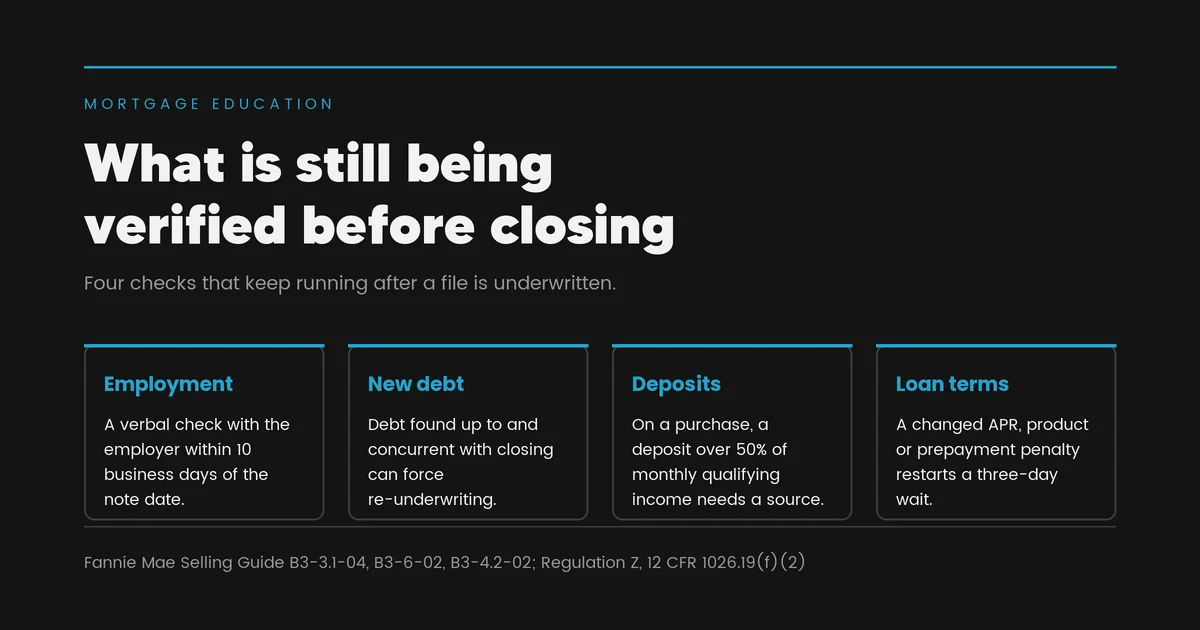
Underwriting approves a file as it looked on a given day. Before the note date, the lender confirms the picture still holds: employment, any debt taken on since, deposits that appeared in your accounts. New debt or reduced income found up to and concurrent with closing can send the file back through underwriting.
None of that is suspicion, and none of it is a second application. It is the same file being checked against the same rules a little later in its life. What surprises people is which parts of it are mandatory, which are the lender’s choice, and how differently those two categories behave.
An approval describes one day.
The word approved gets used loosely, and it hides a distinction that matters here. Underwriting produces a decision about a documented file, with conditions attached, on the date it was made. It does not produce a promise about a file that has since changed.
A preapproval sits even further back. It is a preliminary review based on the information available at the time it is issued. It is not a final approval and not a commitment to lend. The result can change if income, employment, credit, debts, funds for closing, the property, the appraisal, or program requirements change, and it remains subject to full underwriting and verification.
The date the file actually has to be true on is the note date, the day you sign. Everything below is about the gap between the underwriting decision and that day.
Employment gets confirmed close to the note date.
For a conventional loan a lender intends to sell to Fannie Mae, this one is not optional and it is not vague. The Selling Guide requires a verbal verification of employment for every borrower whose employment or self-employment income is being used to qualify, and it sets the window precisely: within 10 business days before the note date for employment income, and within 120 calendar days before the note date for self-employment income.
The guide is unusually direct about why. The requirement exists to help the lender confirm, as late in the process as possible, that the borrower remains employed as disclosed on the loan application, because a change in employment status could significantly affect capacity to repay and must be fully reevaluated.
A phone call is the default method, and the lender has to find the employer’s number independently rather than dialing whatever is on the paperwork. There are alternatives. A written verification works, so does an email exchange from the employer’s own work email address, provided the lender does additional diligence to confirm the address is genuine. Military borrowers and self-employed borrowers each have their own documented paths.
One detail explains why a processor will chase this so hard in the last week: the guide allows the verbal verification to be obtained after closing, up to the time of loan delivery, but if it cannot be obtained before delivery, the loan is ineligible for sale to Fannie Mae. The check does not stop mattering once you have signed.
The practical version is short. Do not resign, do not move from salaried to contract work, and do not start a new job in the week of closing without telling your loan officer first. A change is not automatically fatal. A change nobody knew about until the verification call is a different problem.
The credit part is not what most people assume.
Almost everyone has heard some version of do not open a credit card before closing. The rule underneath it is more interesting than the warning.
The Consumer Financial Protection Bureau lists three ordinary times a lender runs a credit check: when you apply for credit, just before you close on a loan, and as part of managing existing accounts. So a look at your credit late in the process is normal, and it is not a sign that something has gone wrong.
What is not required is a whole new report. Fannie Mae’s Selling Guide says plainly that the lender is not required to obtain a new credit report to verify additional debt. Then it attaches a consequence: if the lender chooses to obtain a new credit report after the initial underwriting decision was made, the loan must be re-underwritten. Pulling a fresh report is a decision with a cost, not a formality, which is part of why lenders lean on undisclosed-debt monitoring services and direct questions instead.
It also matters who is doing the looking. When an existing lender pulls your credit, the CFPB says that is a soft inquiry and it does not affect your score. If you want the difference between the two kinds of pull spelled out, that is the subject of hard and soft credit inquiries in a mortgage file.
Sometimes a late look turns up something that is simply wrong rather than something new. If that happens, the correction runs on the federal dispute timeline, and that clock does not compress because a closing date exists. Say so early rather than at the closing table.
What actually sends a file back through underwriting.
Here the Selling Guide is specific enough to quote. If the borrower discloses, or the lender discovers, additional debt or reduced income after the underwriting decision was made, up to and concurrent with loan closing, the loan must be re-underwritten if the new information causes the debt-to-income ratio to increase by more than the allowed tolerances.
Read the word discloses. Telling your lender is one of the two ways this starts, and it is the ordinary one. Volunteering a new car payment is not a confession. It is the input the process expects.
Two things sit outside the tolerance test. New subordinate financing on the subject property triggers re-underwriting in all cases, with no threshold to clear first. And if the recalculated ratio exceeds 45 percent on a manually underwritten loan, or 50 percent on a loan run through Desktop Underwriter, Fannie Mae will not accept delivery of it. That is an eligibility rule about which loans Fannie Mae will buy. It is not a prediction about any individual file, and it is not the only set of numbers in the market, since other investors and programs set their own.
Reduced income belongs in the same sentence as new debt, and it gets less attention. Losing a shift differential, dropping to part-time hours, or ending a second job moves the same ratio in the same direction as a new loan payment.
Money landing in your accounts gets read, not just counted.
Assets are documented in the same spirit. The Selling Guide defines a large deposit as a single deposit that exceeds 50 percent of the total monthly qualifying income for the loan, and when bank statements are used, the lender has to evaluate those deposits.
What follows depends on the transaction. On a purchase, if funds from a large deposit are needed for the down payment, closing costs, or reserves, the lender must document that those funds came from an acceptable source. A written explanation, proof of ownership of an asset that was sold, or a copy of a wedding invitation supporting receipt of gift funds are all examples the guide gives. Undocumented amounts get subtracted from your verified funds, and the reduced number is what underwriting has to work with.
On a refinance, documentation or explanation for large deposits is not required, though the lender remains responsible for making sure any borrowed funds and any related liability are accounted for. Borrowed money does not become gift money by passing through a checking account.
The workable habit is to document deposits when they happen rather than reconstructing them under time pressure. A gift letter written the week of closing is the same document it would have been a month earlier, only harder to get.
What a change does to the closing paperwork.
A change to the file can move the numbers on your Closing Disclosure, and Regulation Z decides what that costs in time.
The baseline is that you have to receive the Closing Disclosure no later than three business days before consummation. The CFPB puts the same rule in consumer terms and adds a practical note: your lender is required to send it at least three business days before closing, and you can request the rest of your closing documents in advance.
If the disclosures become inaccurate before consummation, the creditor has to provide corrected disclosures with the changed terms so you receive them at or before consummation. Most corrections land here. They do not restart anything.
Three changes do restart the three-business-day clock, and the rule names them: the annual percentage rate becoming inaccurate as Regulation Z defines inaccuracy, the loan product changing, or a prepayment penalty being added. If you have heard that any change to the file delays closing by three days, this is the real version of it, and it is much narrower.
Since the first of those three turns on the annual percentage rate, the terms you locked and the way a lock is documented are worth understanding before this stage. That is covered in what to confirm when you lock.
If something already changed.
Tell your loan officer the day it happens, and put it in writing so there is a record of when you said it. Early disclosure gives the file time to be reworked. Late discovery gives it none.
Regulation B sets the outside timing on the answer you get back. A creditor has 30 days after receiving a completed application to notify you of its approval, a counteroffer, or adverse action. When an application is incomplete in ways you can fix, the creditor has 30 days from receiving it to notify you, either of the action taken or of what is missing. Those are ceilings on notice, not the pace of an active file, and they say nothing about what any particular decision will be.
Which rulebook is sitting on your file.
Every Selling Guide requirement above governs conventional loans a lender intends to deliver to Fannie Mae. That covers a lot of Texas mortgages and it does not cover all of them. FHA, VA, USDA, and loans a lender keeps in its own portfolio each run on their own requirements, similar in kind and not identical in detail, and the Regulation Z and Regulation B rules apply across them.
So the useful question early in a file is which set applies to yours, and what specifically will be reverified in the last two weeks. A loan officer can answer that on the day you ask. For the wider map of who is responsible for what along the way, see who does what from preapproval to closing.
Official sources.
These primary sources were opened and reviewed for this article on August 29, 2026.
- Fannie Mae. Selling Guide B3-3.1-04, “Verbal Verification of Employment.” Topic dated March 4, 2026 on the page. Accessed August 29, 2026.
- Fannie Mae. Selling Guide B3-6-02, “Debt-to-Income Ratios.” Carries the re-underwriting criteria for debt or reduced income found up to and concurrent with closing. Topic dated April 2, 2025 on the page. Accessed August 29, 2026.
- Fannie Mae. Selling Guide B3-4.2-02, “Depository Accounts.” Defines a large deposit and the documentation that follows on purchase and refinance transactions. Topic dated December 14, 2022 on the page. Accessed August 29, 2026.
- Consumer Financial Protection Bureau. 12 CFR § 1026.19(f), Closing Disclosure timing and subsequent changes (Regulation Z). eCFR shows title 12 current as of August 27, 2026, last amended August 26, 2026. Accessed August 29, 2026.
- Consumer Financial Protection Bureau. 12 CFR § 1002.9, “Notifications” (Regulation B). eCFR shows title 12 current as of August 27, 2026, last amended August 26, 2026. Accessed August 29, 2026.
- Consumer Financial Protection Bureau. “When will my lender run or obtain a copy of my credit report?” Page shows last reviewed December 31, 2024. Accessed August 29, 2026.
- Consumer Financial Protection Bureau. “What should I do before, during, and after the mortgage closing process?” Page shows last reviewed June 27, 2024. Accessed August 29, 2026.
Educational information. This article describes published investor requirements and federal regulations as they read on the access dates above. It is not legal advice, a credit decision, a loan approval, or a commitment to lend, and it does not predict any approval, decision, term, or closing date. Requirements differ by loan program and by lender, and they change. Ask the loan officer handling your file which requirements apply to it.