
Mortgage education
How to Dispute an Error on Your Credit Report
Federal law gives you a dispute process with deadlines the other side has to meet, and you can start it online, by mail, or by phone. Knowing which company to contact, and what the answer has to contain, is most of the work.
The short answer.
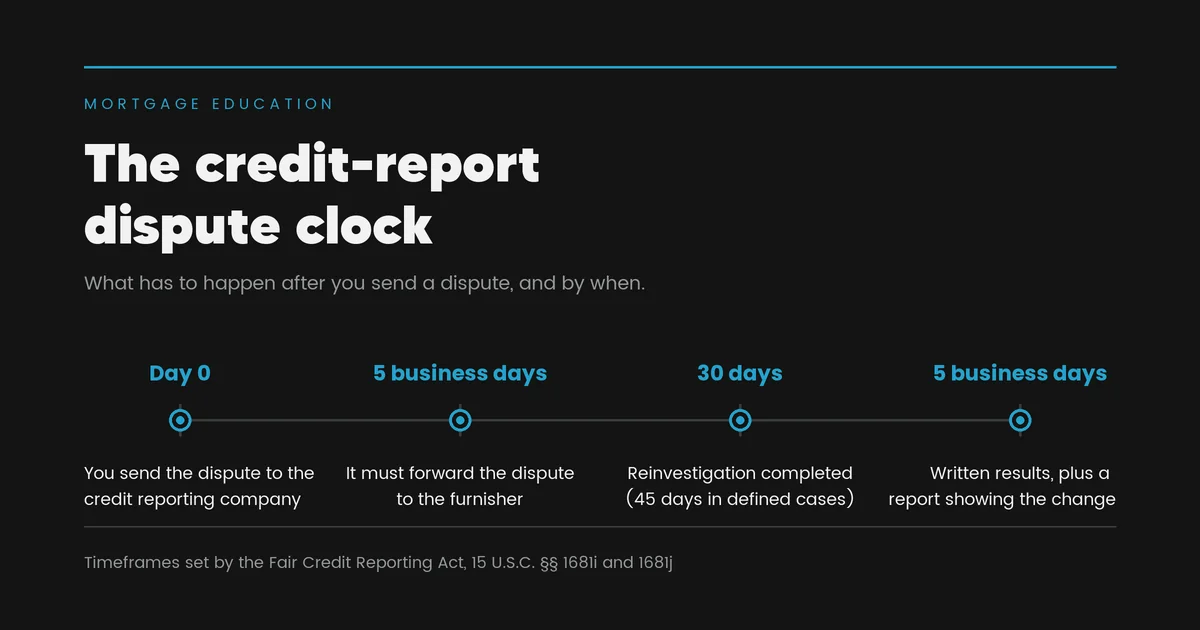
Dispute with the credit reporting company online, by mail, or by phone, and dispute with the business that reported the item too. The reporting company generally has 30 days to reinvestigate, longer in defined cases, and must send you written results within five business days of finishing.
That is the whole path in one paragraph, but the parts that trip people up are the details: which company to contact, what the dispute has to contain, and what the answer means when an item is confirmed rather than removed. A dispute is not a request for a favor. It starts a process with defined duties and defined deadlines on the other side.
Start with the report itself.
You cannot dispute an item precisely until you are looking at it. The Consumer Financial Protection Bureau says you have the right to one free copy of your credit report each year from each of the three nationwide companies through AnnualCreditReport.com, and that you may be able to view free reports more often online. Pull all three. An item can sit on one report and not the others, because furnishers do not all report to every company.
Then be specific about what is wrong. A dispute works on information that is inaccurate or incomplete: an account that is not yours, a balance that was paid, a late payment that never happened, a closed account still showing open. It is not a tool for removing accurate history you would rather not have on the file. Disputing something correct wastes the one process you may need later for something that is genuinely wrong.
There are two places to send a dispute, and they do different things.
The CFPB puts it plainly: fixing an error generally means contacting both the credit reporting company and the company that provided the information. Those two routes are not duplicates of each other, and they do not carry the same rights.
The credit reporting company.
This is the route most people mean when they say they disputed something. You file with Equifax, Experian, or TransUnion, whichever ones show the item. The CFPB says you can contact the nationwide credit reporting companies online, by mail, or by phone, and it lists a dispute page and a dispute phone number for each. The company has to investigate, forward your dispute and the material you sent to the business that reported the item, and report the results back to you.
This route also preserves something the other one does not. If the reinvestigation ends without resolving the dispute, you can ask that a statement about it be added to your file. That right attaches to disputes filed with the credit reporting company.
Whichever route you use, keep your own record of what you disputed and when you sent it.
The company that reported the item.
The business that supplied the information is called a furnisher, and you can dispute directly with it. Regulation V requires a furnisher to reasonably investigate a direct dispute about your liability for an account, the terms of the account, your performance or conduct on it, or other information in a consumer report bearing on your creditworthiness.
Two conditions matter here. The first is the address. A furnisher only has to investigate if you send the dispute to the address it provided on your consumer report, an address it clearly specified for receiving disputes, or, if it has specified none, any of its business addresses. A letter to the wrong department may accomplish nothing.
The second is scope. The direct dispute rule does not reach everything. It excludes your identifying information, the identity of past or present employers, information taken from public records unless the furnisher has an account relationship with you, information tied to fraud or active duty alerts, information another furnisher supplied, and inquiries or requests for a consumer report. If you do not recognize an inquiry, a direct dispute to a furnisher is the wrong instrument for it.
What the dispute needs to contain.
The CFPB says to explain what you think is wrong and why, and to include copies of the documents that support you. For a mailed dispute to a credit reporting company it lists the specifics: your full name, address, and telephone number; the report confirmation number if you have one; each error you want fixed, with the account number for any account in question; a clear explanation of why you are disputing it; a request that the information be removed or corrected; a copy of the portion of the report showing the disputed items, circled or highlighted; and copies, not originals, of the documents that support you. Have those same facts in front of you if you dispute online or by phone.
The bureau publishes template letters for both routes, one for the credit reporting company and one for the furnisher. It also suggests sending by certified mail with a return receipt so you have proof of delivery. Keep a copy of everything you send.
A direct dispute to a furnisher has its own required contents under Regulation V: enough information to identify the account, the specific information you are disputing along with the basis for the dispute, and the supporting documentation the furnisher reasonably needs. The rule gives examples, including the relevant portion of the consumer report, a police report, a fraud or identity theft affidavit, a court order, or account statements.
The clock, step by step.
The Fair Credit Reporting Act sets the timing, not the company you wrote to. Four deadlines run once your dispute lands.
Within five business days of receiving your dispute, the credit reporting company has to notify the business that furnished the item and pass along the relevant information you provided.
Within 30 days of receiving your notice, it has to conduct a reasonable reinvestigation, free of charge, and either record the current status of the item or delete it. That 30-day period can be extended by no more than 15 additional days if you send in relevant information during the original 30 days. The extension is not available if the item has already been found inaccurate or incomplete, or if the company has determined it cannot be verified.
A separate provision sets a different clock. If you dispute after receiving your free annual file disclosure, the reinvestigation gets 45 days from the date your dispute request is received, in place of the 30-day period. So there are two ways a reinvestigation can run to 45 days, and they do not depend on each other.
Within five business days of completing the reinvestigation, it has to send you written results. That notice includes a statement that the reinvestigation is finished, a consumer report reflecting the file as revised, notice that you may request a description of how the accuracy was determined, and notice of your right to add a statement to the file.
If you ask for that description of the procedure, it has 15 days to provide it, including the name, address, and, where reasonably available, the telephone number of any furnisher it contacted.
Direct disputes to a furnisher run on a comparable schedule. The CFPB says furnishers generally must investigate and respond within 30 days of receiving the dispute, and Regulation V ties the furnisher deadline to the same statutory period that would apply if you had gone through the credit reporting company.
The answer comes back as one of three things.
The first outcome is a correction. If the item is found inaccurate or incomplete, or cannot be verified, the credit reporting company has to promptly delete or modify it and tell the furnisher what changed. If a furnisher finds it reported something inaccurate, it has to notify every credit reporting company it sent that information to and supply the correction.
The second outcome is that the item stands. The furnisher reviews it, concludes the information is accurate, and nothing is removed. This is a real result, not a failure of the process, and it is the point at which most people stop. There is more available after it.
The third outcome is a determination that the dispute is frivolous or irrelevant, which lets the company terminate the reinvestigation. That word sounds harsh, but the most common trigger is mundane: not enough information to investigate, such as a dispute that never specifies which item is wrong. The company has to notify you within five business days, give its reasons, and identify what it would need. Treat that letter as a correctable defect. Supply the missing detail and send it again.
If the item stays, you can attach a statement to it.
When the reinvestigation does not resolve the dispute, you may file a brief statement describing it. The credit reporting company may hold that statement to 100 words if it helps you write a clear summary. Once filed, any later report containing the disputed item has to note that you dispute it and include your statement or an accurate summary of it.
There is a limit worth knowing before you choose a route. The CFPB says the right to include a statement in your file applies to disputes you submitted to a credit reporting company, not to disputes you sent directly to the furnisher. If you only wrote to the furnisher and it concluded the information was accurate, go back to the credit reporting companies and ask them to include the statement.
A deleted item can be put back.
Deletion is not always permanent, and this is the part that surprises people months later. Information removed after a reinvestigation may not be reinserted unless the furnisher certifies that it is complete and accurate.
If it is reinserted, the credit reporting company has to tell you in writing within five business days, give you the business name, address, and telephone number of the furnisher involved where reasonably available, and notify you of your right to add a statement. Keep your results letter. If the correction matters to a decision someone is about to make, look at the report again close to that decision rather than trusting a letter from two months earlier.
File the dispute yourself.
There is a specific reason to file your own dispute rather than pay a company to file one for you. Regulation V says a furnisher does not have to investigate a direct dispute when it reasonably believes the dispute was submitted by a credit repair organization, prepared on the consumer’s behalf by one, or submitted on a form that one supplied.
Read that as a practical consequence rather than a legal opinion: routing your dispute through a paid credit repair service can remove the furnisher’s obligation to investigate it. A dispute you filed yourself, describing an error you identified, with documents you supplied, does not carry that problem.
If a loan file is already open.
The deadlines above do not compress because someone is under contract. A reinvestigation that can take 30 days takes 30 days whether or not a closing date is on the calendar, which is the argument for reviewing your reports before you start rather than during.
If you are already in process, tell the loan officer handling your file what you disputed and when, and keep the written results when they arrive. Lenders commonly review credit again later in a file, so a correction that posts after the first review may not be reflected in what they are looking at. What the correction does to any score, decision, or loan term is not something an article can tell you, and no one should predict it in advance.
Official sources.
These primary sources were opened and reviewed for this article on August 28, 2026.
- Consumer Financial Protection Bureau. “How do I dispute an error on my credit report?” Page shows reviewed December 12, 2024; modified December 18, 2024. Accessed August 28, 2026.
- Office of the Law Revision Counsel, U.S. House of Representatives. 15 U.S.C. § 1681i, “Procedure in case of disputed accuracy.” Page shows the text contains laws in effect on August 27, 2026. Accessed August 28, 2026.
- Office of the Law Revision Counsel, U.S. House of Representatives. 15 U.S.C. § 1681j(a)(3), “Reinvestigations.” Sets the 45-day period for a reinvestigation requested after receiving a free annual file disclosure. Page shows the text contains laws in effect on August 27, 2026. Accessed August 28, 2026.
- Consumer Financial Protection Bureau. 12 CFR § 1022.43, “Direct disputes” (Regulation V). eCFR shows title 12 current as of August 27, 2026, last amended August 26, 2026. Accessed August 28, 2026.
- Consumer Financial Protection Bureau. “What if I disagree with the results of my credit report dispute?” Page shows reviewed January 29, 2024. Accessed August 28, 2026.
- Consumer Financial Protection Bureau. “How long does it take to repair an error on a credit report?” Page shows reviewed September 5, 2025. Accessed August 28, 2026.
- Consumer Financial Protection Bureau. “How do I get a free copy of my credit reports?” Page shows reviewed August 28, 2023. Accessed August 28, 2026.
If a credit reporting company or a furnisher does not respond, or responds inadequately, the CFPB accepts consumer complaints and describes further options, including adding a statement to your file and speaking with a lawyer.
Educational information. This article provides general information about a consumer right under federal law. It is not legal advice, a credit decision, a loan approval, or a commitment to lend, and it does not predict any score, decision, or mortgage outcome. Company procedures vary. Ask the company handling your dispute or your loan file how its process applies to you.