
Mortgage education
Value Acceptance and the Limits of an Appraisal Waiver
Being told your file might not need an appraisal raises a fair question: what replaced it, and what did you give up? This walks through where the offer comes from, the transactions it never covers, and what you still receive either way.
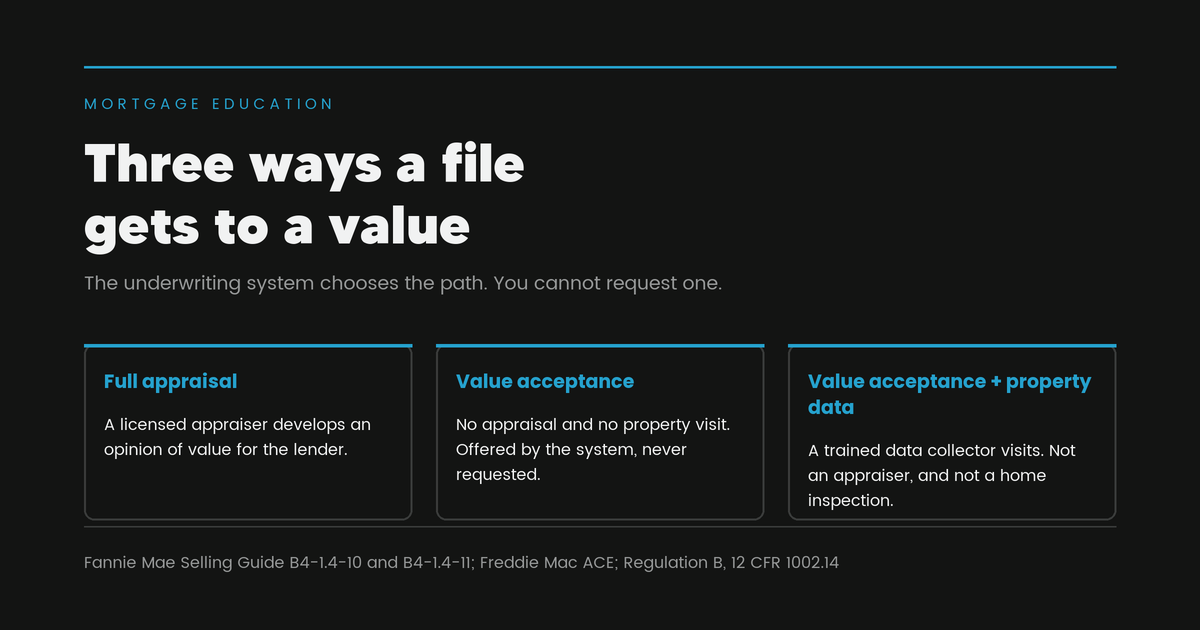
The short answer: it is an offer the system makes, not a step you can skip.
Fannie Mae renamed the appraisal waiver "value acceptance" because the older name described what was missing rather than what was happening. Nothing is being excused. Fannie Mae is accepting the value already in the file, based on data it holds about the property, instead of requiring a new appraisal report. The distinction matters because it explains why nobody involved in your transaction can turn the offer on.
A waiver is offered by the automated underwriting system, not requested by you or your loan officer. It applies to a narrow set of one-unit conventional files, excludes Texas home equity loans outright, and never evaluates the condition of the house. A home inspection is a separate decision.
If you are still mapping out who does what and when, the walkthrough of who does what from preapproval to closing covers the surrounding sequence, and the mortgage basics guide covers the vocabulary.
Where the offer actually comes from.
Value acceptance is returned by Desktop Underwriter, Fannie Mae's automated underwriting system, on certain loan casefiles. As reviewed on September 12, 2026, the Selling Guide states that for certain loan casefiles, DU offers value acceptance, in which case an appraisal is not required. Freddie Mac runs the equivalent through Loan Product Advisor and calls it automated collateral evaluation, or ACE.
Both depend on the agency already holding usable data about the property. Fannie Mae's offer rests on acceptable prior appraisal data in its Collateral Underwriter database. Freddie Mac describes ACE as drawing on proprietary models, decades of historical data, and public records. When that data does not exist or does not support the value, no offer appears, and that is not a judgment about the borrower.
The offer also expires. Fannie Mae requires a value acceptance offer to be exercised within four months of the note date. Freddie Mac publishes its ACE conditions in the Single-Family Seller/Servicer Guide rather than on its public product pages, so ask your loan officer what window applies to your file. A slow contract can quietly cost you the waiver either way.
One more limit runs in the other direction. Fannie Mae's guide is explicit that a lender may not exercise a value acceptance offer if the lender believes an appraisal is warranted based on additional information it has about the property or subsequent events. The offer is a ceiling on what is required, not a floor the lender has to accept.
The transactions value acceptance never covers.
The eligible set is narrower than most borrowers expect. Value acceptance is built around one-unit properties, including condominium units, on principal residence and second home transactions, plus investment property refinances, and only on DU casefiles that returned an Approve/Eligible recommendation. Everything outside that shape needs an appraisal.
| Category | Examples Fannie Mae lists as ineligible |
|---|---|
| Property type | Two- to four-unit properties, co-op units, manufactured homes, leasehold properties |
| Construction | Proposed construction, construction-to-permanent loans, HomeStyle Renovation and Refresh loans |
| Texas-specific | Texas Section 50(a)(6) loans |
| Value and structure | Purchase price or estimated value at or above $1,000,000, gifts of equity, community land trusts and other resale-restricted properties |
| Underwriting path | Manually underwritten loans, and any casefile returning an Ineligible recommendation |
The Texas line is the one worth committing to memory here. A Texas home equity loan made under Section 50(a)(6) of the state constitution is on Fannie Mae's ineligible list, so it needs an appraisal no matter how clean the rest of the file looks. Texas borrowers who have heard from friends in other states that their cash-out refinance skipped the appraisal are comparing two different transactions.
Everything in that table is Fannie Mae's list. Freddie Mac keeps its own ACE eligibility requirements in the Single-Family Seller/Servicer Guide, and they are not a copy of Fannie's. Two agencies, two lists, and your lender delivers to one of them on any given file, so the useful question is which agency's rules your loan runs under rather than what applied to somebody else's.
Buying a condominium? Unit eligibility is only half the question. See how condominium project review affects a mortgage file, because the association behind the unit is underwritten too.
The middle option: value acceptance plus property data.
Between a full appraisal and no property visit at all, Fannie Mae offers value acceptance plus property data. As reviewed on September 12, 2026, the Selling Guide describes it as an option that requires interior and exterior property data collection to verify property eligibility prior to the note date, with no appraisal required.
The visit is made by a property data collector rather than an appraiser. Fannie Mae requires that person to be trained and vetted, to pass annual background checks, to receive professional training, and to stay independent of the transaction. The lender is responsible for verifying that the collector meets those requirements. Freddie Mac runs a comparable option alongside ACE using a property data report.
What the collection finds can still change the outcome. Where the data reveals deficiencies, Fannie Mae's guide says the lender may need to obtain a professionally prepared report from a qualified professional to confirm the property is eligible, and where repairs are necessary, the lender needs documentation that the condition was corrected before the loan is delivered. A visit that turns up a real problem can put the file back on the appraisal path it looked like it had avoided.
A waiver is not an inspection, and it never was.
An appraisal is an opinion of value prepared for the lender, so that the lender knows what its collateral is worth. It is not a consumer protection report about whether the house is sound, and removing it does not remove a protection you had.
This is the point where the two things most often get conflated. A borrower hears that the appraisal was waived and reasonably concludes that nothing about the property was examined. Under value acceptance, that is close to accurate: no appraiser goes to the house. Under value acceptance plus property data, somebody does visit, but a data collector documents the property, and that is not the same task as an inspector evaluating systems and condition on your behalf.
Either way, a home inspection is a separate service you arrange and pay for, and the decision to get one should not move because an underwriting system made an offer. The checks that do continue running on your file are a different category entirely; reverification before closing covers those.
What you still receive when there is no appraisal.
Regulation B entitles you to copies of valuations, not specifically to an appraisal. As reviewed on September 12, 2026, 12 CFR 1002.14(a)(1) requires a creditor to provide an applicant a copy of all appraisals and other written valuations developed in connection with an application for credit that is to be secured by a first lien on a dwelling.
Three details in that rule tend to surprise people. The copies come promptly upon completion or three business days before consummation, whichever occurs first, so they are not something handed over at the closing table. The creditor has to send written notice of your right to receive them no later than three business days after receiving your application. And the creditor cannot charge you for providing the copies, though it may still charge for the valuation itself.
The rule defines valuation broadly: any estimate of the value of a dwelling developed in connection with an application for credit. So the question to ask is not "where is my appraisal" but "what written valuation was developed on my file, and when will I get it." If a written valuation exists, you are entitled to a copy without asking for one. If your file genuinely received a waiver and no written valuation was developed, there may be no document to send, which is itself a useful thing to have confirmed in writing.
If your loan is not a Fannie Mae or Freddie Mac loan.
Value acceptance and ACE are Fannie Mae and Freddie Mac programs, delivered through those two agencies' own underwriting systems. They describe what those agencies will buy. They do not set the valuation rules for loan programs backed by other agencies.
If you are using VA financing, the valuation requirements come from the VA rather than from Desktop Underwriter or Loan Product Advisor, and the property requirements attached to that program are their own subject. The VA appraisal and property requirements page covers that path. The practical step for any borrower is the same: ask your loan officer which agency's rules your specific file runs under before assuming a waiver is available, because the answer changes the entire question.
Questions worth asking on your own file.
- Did the automated underwriting system return a value acceptance or ACE offer on my file, or is an appraisal being ordered?
- If an offer came back, when does it expire, and does my expected closing date fall inside that window?
- Is this value acceptance, or value acceptance plus property data? If it is the second, who is visiting the property and when?
- Was any written valuation developed on my file, and when should I expect my copy under Regulation B?
- Is anything about this transaction on the ineligible list, particularly if it is a Texas Section 50(a)(6) loan, a two- to four-unit property, or new construction?
None of this changes whether you should hire a home inspector, and none of it is a promise about what any particular file will receive. Eligibility is determined by the agency's system on your actual loan casefile, not in advance and not on request.
Official sources used for this article
This article cites agency and regulatory sources for the requirements it summarizes. Source pages change. Review the linked material directly and confirm current requirements with the appropriate professional.
- Fannie Mae Selling Guide B4-1.4-10: Value Acceptance (Appraisal Waiver)States that DU offers value acceptance, the eligibility conditions, the four-month exercise window, the ineligible transaction list including Texas Section 50(a)(6), and the lender's discretion to require an appraisal anyway. Section shown as updated June 3, 2026. Accessed September 12, 2026.
- Fannie Mae Selling Guide B4-1.4-11: Value Acceptance + Property DataDescribes the interior and exterior property data collection, the trained and vetted data collector requirements, and what happens when deficiencies are found. Section shown as updated December 10, 2025. Accessed September 12, 2026.
- Freddie Mac: Automated Collateral Evaluation (ACE)Describes ACE as a Loan Product Advisor capability using proprietary models, historical data, and public records in place of an appraisal report. Accessed September 12, 2026.
- Freddie Mac: Automated Collateral Evaluation (ACE) General FAQFreddie Mac's general answers on ACE, including whether a fee is charged to assess ACE eligibility and how Freddie Mac addresses valuation and condition risk without an inspection of the property. Detailed eligibility requirements sit in the Seller/Servicer Guide rather than on this page. Accessed September 12, 2026.
- Consumer Financial Protection Bureau: Regulation B, 12 CFR 1002.14Sets the requirement to provide copies of all appraisals and other written valuations, the timing and notice rules, the prohibition on charging for copies, and the definition of valuation. Accessed September 12, 2026.
- Texas Department of Savings and Mortgage Lending: Mortgage Origination Laws and RulesCurrent index of Texas Administrative Code Title 7, Part 4 chapters governing mortgage origination. Accessed September 12, 2026.
Information reviewed: The primary sources cited in this article were checked on . This article provides general mortgage education and is not legal advice, tax advice, or a promise of loan approval. It does not predict what any individual loan file will receive. Read our editorial policy.